One Ball That Can Win a Match
Last over. Six runs needed. Your best batter is on strike, bat raised, ready to launch one into the stands. The crowd is on its feet. The bowler walks back to his mark.
And then he bowls a yorker. The ball skids under the bat, clips the base of the stumps, and the innings is over.
That is what the yorker can do. In a format where every delivery carries enormous weight, it is the single most decisive ball a bowler can produce.
What Exactly Is a Yorker
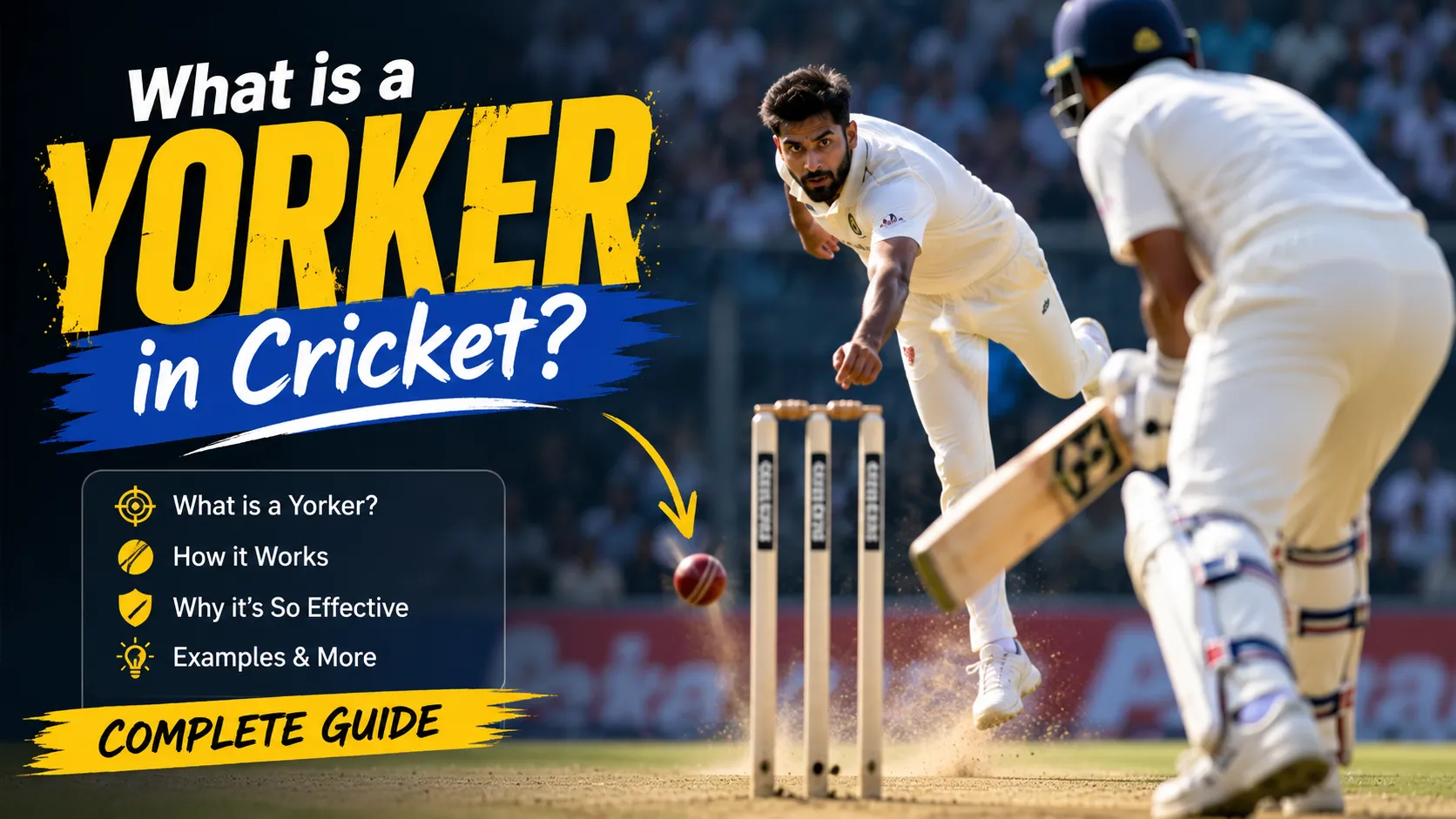
A yorker lands right at the batter's feet, on or just inside the popping crease. It is not a short ball the batter can pull. It is not a length ball they can drive. It pitches so close to their body that there is almost no room to generate a proper swing.
The margin between a perfect yorker and a disaster is incredibly thin. Too full and it becomes a full toss, sitting up for the batter to hit over the boundary. Too short and it sits up as a half volley, equally easy to hit hard. The ideal landing zone is probably the size of a cricket bat itself.
Hitting that zone consistently, under extreme pressure, at high pace, is one of the hardest skills in the game.
Why Batters Struggle Against It
Stand in a batter's shoes for a moment. A fast bowler running in at 140 kilometres per hour gives you less than half a second to react from the moment the ball leaves their hand.
When a yorker is bowled well, you have to make several physical adjustments almost simultaneously. Your weight needs to shift back slightly, your knees need to drop, your bat has to come down steeply through a very narrow channel. You cannot follow through with a full swing because the ball is too close to your feet. You cannot step back because there is no time and no room.
The best you can usually do against a perfect yorker is dig it out for a single. If your feet are not in the right position when it arrives, you are in serious trouble. The stumps are right behind you, and there is nowhere to hide.
The Death Overs and Why Yorkers Rule Them
T20 cricket splits neatly into phases. The powerplay at the start. The middle overs. And then the death, roughly the final four to six overs, where the batter is trying to score as many runs as possible and the bowler is trying to prevent exactly that.
This is where the yorker becomes the most important delivery in the game.
Batters in the death overs are not playing conservatively. They are targeting every ball for a boundary. A bowler who tries to bowl a good length in this phase will get hit. The batter has enough time to transfer weight and hit through the line.
A yorker removes that time and space completely. It forces the batter to play defensively in a phase of the game where defending feels like defeat. Even a dot ball in the last over can change the momentum of an innings.
The best death bowlers in the world are the ones who can bowl yorkers not occasionally but consistently, under the highest pressure imaginable, when the entire game is riding on their execution.
The Mental Battle Happening Simultaneously
While all this physical skill is playing out, there is a separate mental contest running in parallel.
The batter knows a yorker is coming. The bowler knows the batter knows. So the batter might shuffle deep into the crease to change the length, trying to turn the yorker into a half volley. Or they might step across their stumps to disrupt the bowler's natural line.
A smart bowler adjusts. He aims at the toes instead of the base of the stumps, knowing the batter has moved. He might bowl two good length balls first to set up the yorker, making the batter commit to their front foot before pulling the ball back in under their feet.
This reading and countering and re reading is happening within fractions of a second, across multiple deliveries, between two people who have studied each other extensively. The yorker is the physical weapon. The mind game around it is equally important.
Variations That Make It Even Harder to Play
The basic yorker is difficult enough. But bowlers have developed variations that add another layer of complexity.
The slower yorker is perhaps the most deceptive. The bowler goes through the same action but releases the ball off the back of the fingers, cutting the pace significantly. A batter who times their swing for a 140 kilometre per hour ball will be nowhere near a 110 kilometre per hour yorker. The timing is completely disrupted.
The swinging yorker moves in the air before pitching near the feet. If a batter is already in trouble adjusting their body position, the added lateral movement makes it almost impossible to get a clean hit.
The wide yorker is aimed at the outside edge of the crease rather than the stumps. This removes the batter's ability to even dig it out toward the leg side and forces a cramped, awkward shot.
Each variation uses the same basic principle of landing close to the feet, but the unpredictability of which version is coming adds another problem the batter has to solve in real time.
How Bowlers Actually Master It
Nobody bowls a perfect yorker the first time they try. It is one of those deliveries that requires thousands of repetitions before it feels natural.
Bowlers work specifically on their release point, the exact moment the ball leaves the fingers and the precise angle at which it does. A small change in how you hold the seam can alter where the ball pitches by a metre or more. Getting that release point locked in, so it becomes automatic under pressure, takes serious dedicated practice.
They also work on their run up and body position. A yorker bowled off a slightly different stride length will land in a different spot. Consistency in the approach to the crease is as important as the delivery itself.
The mental side is trained too. Coaches put bowlers in pressure scenarios, last over simulations with runs needed and fielders in specific positions, so that when the real moment comes it does not feel entirely new.
What Separates the Good From the Great
Many bowlers can bowl a yorker in a nets session. The skill is reproducing it in the last over of a T20 final, with a hundred thousand people watching, when the game depends on the next ball.
The great death bowlers do not just have the physical skill. They have the temperament to reach for that delivery when everything is on the line, to commit fully to a ball they know has a thin margin for error, and to back themselves completely.
That combination of technical precision and mental composure under extreme pressure is rare. When you see a bowler produce a perfect yorker in the most pressurized moment of a match, you are watching something genuinely special.
A Delivery That Defines the Modern Game
T20 cricket made the yorker more important than it has ever been. As bats got heavier, batting techniques became more powerful, and boundary sizes stayed the same, bowlers needed something that could not simply be muscled over the rope.
The yorker is the answer to that problem. It takes pace away from the batter, removes the hitting arc, and demands a defensive response in a format built entirely around aggression.
The next time a bowler runs in during the final over and the batter shapes up to hit, watch where the ball lands. If it skids under the bat and the batter jams it out awkwardly for no run, what you just watched was not a lucky delivery.
It was the product of thousands of hours of work, a precise decision made under pressure, and one of the most skillful things a human being can do with a cricket ball.
That is the yorker. And that is why it decides T20 matches.