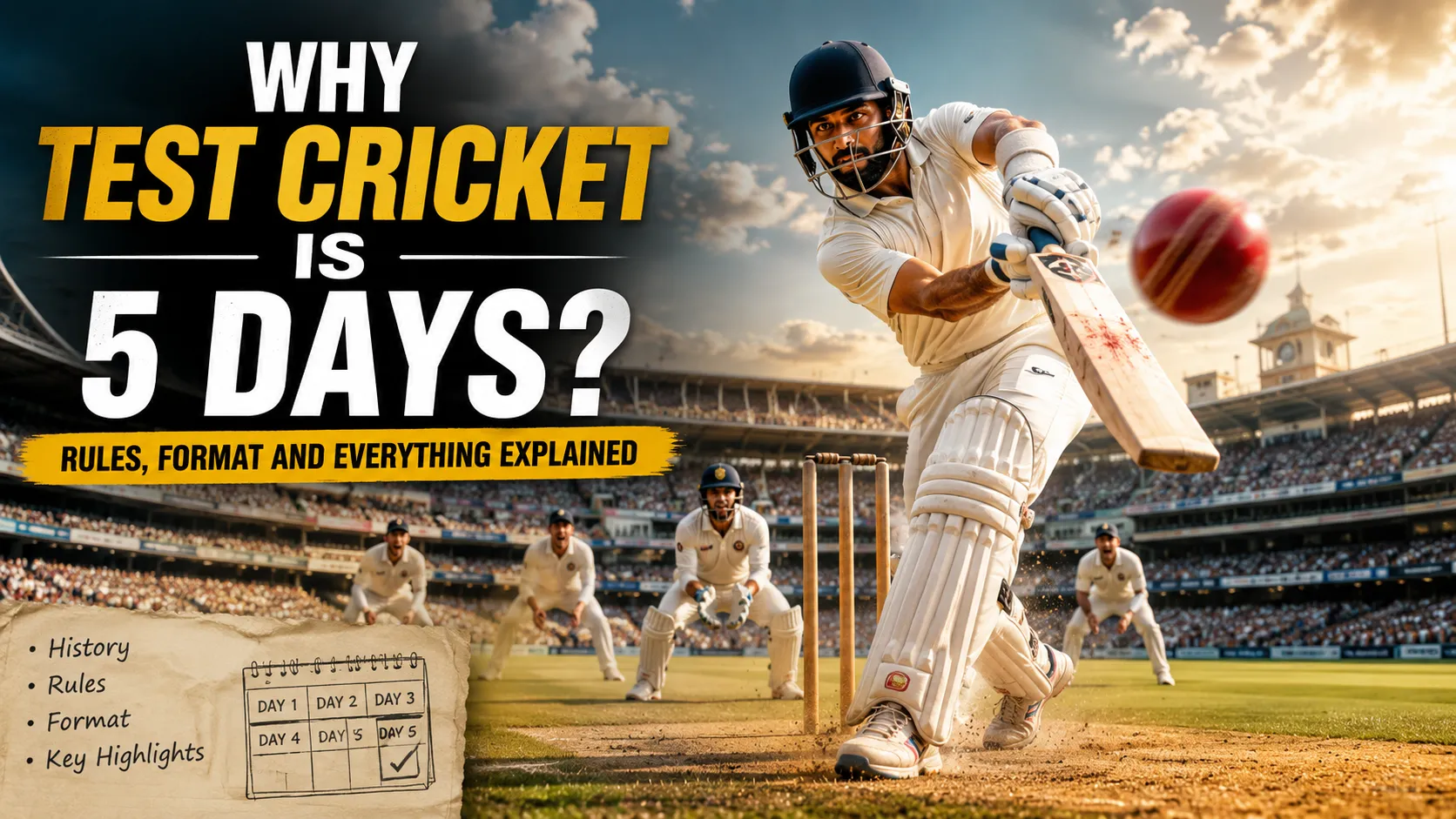
Why Test Cricket is 5 Days: Rules, Format and Everything Explained
Every new cricket fan asks the same question eventually. Why does a Test match last five days? T20 cricket finishes in three hours. Even ODI cricket wraps up in a day. So why does the format considered the pinnacle of the sport take five full days to complete and why is that duration not considered too long but rather essential to what makes Test cricket what it is?
The answer involves the specific rules of Test cricket, the nature of what the format is designed to test, and the way a five-day contest produces a depth of drama, strategy, and sporting achievement that no shorter format can replicate.
What Test Cricket Actually Is and Where the Name Comes From
Test cricket is the oldest and most prestigious form of international cricket, with the first officially recognised Test match played between England and Australia in Melbourne in March 1877. The name itself tells you everything about what the format is designed to do it is a test of a team's complete cricketing ability across every dimension the game contains.
Skill under pressure across extended periods. Concentration maintained through hours of fielding or hours at the crease. Physical endurance across five consecutive days of play. Tactical intelligence across multiple sessions and multiple days as match situations evolve. Mental resilience through difficult passages of play and through the natural momentum swings that a five-day contest produces.
Test cricket is explicitly designed to test all of these things simultaneously, and the five-day duration is not incidental to that design it is fundamental to it. A shorter format cannot produce the same test because many of the qualities being assessed only reveal themselves across extended time.
The five-day standard for Test matches was not always fixed from the beginning. Early Test matches varied in length and some were played as timeless Tests matches that continued until a result was achieved regardless of how many days that required. The longest timeless Test, played between England and South Africa in 1939, lasted nine playing days before being abandoned as a draw because England needed to catch their ship home. The five-day standard gradually became established through the mid-twentieth century and has been the fixed duration for Test cricket since 1950.
The Core Rule That Makes Five Days Necessary Two Innings Per Team
The most fundamental structural difference between Test cricket and all limited overs formats is that each team bats twice. Four innings must be completed or reach their natural conclusion through dismissals for a Test match to produce a result.
In T20 cricket and ODI cricket each team faces a fixed number of overs in a single innings. One innings per team, result at the end. In Test cricket there are no overs limits on innings. Each team's innings continues until all ten wickets have been taken or until the batting captain declares, voluntarily ending their innings to give the bowling side time to win.
For a team to win a Test match they must score more runs across their two innings combined than the opposition scores across their two innings combined, and they must bowl out the opposition twice meaning they must take all twenty of the opposition's wickets. That is a significantly more demanding requirement than winning a single-innings match, and it requires significantly more time.
A typical Test match day consists of three sessions of approximately two hours each, with a forty-minute lunch break and a twenty-minute tea break between sessions. Six hours of actual playing time per day across five days gives a potential maximum of thirty hours of play enough time to complete four innings, absorb weather interruptions, and still produce a meaningful contest.
How a Test Match Unfolds Session by Session
Understanding Test cricket's format means understanding how matches develop across their structure rather than simply knowing the total duration.
Day one of a Test match typically begins with the toss, which determines which team bats first. The toss has greater significance in Test cricket than in limited overs formats because pitch conditions change substantially across five days, and choosing whether to bat first or bowl first can be influenced by the expected trajectory of that deterioration.
The first session on day one almost always favours the bowling side. The pitch is freshest and firmest, offering the most assistance to fast bowlers through seam movement and bounce. The ball is new and harder, more capable of swinging through the air and cutting off the pitch. Experienced batting sides understand this and target survival through the first session before looking to score more freely as the ball ages.
As the match progresses across days two and three, the pitch typically flattens out after its initial freshness is spent. This middle phase often favours batting, producing higher scoring sessions that allow teams to build substantial totals. The ball is older and less lively, and the pitch surface while worn has not yet begun deteriorating in ways that assist spin.
Days four and five of a Test match produce the most dramatic cricket of the contest. The pitch by this point has worn significantly through the impact of the ball, players' boots, and natural drying. Cracks appear, particularly on a good length, causing the ball to deviate unpredictably on pitching. Spin bowlers find dramatically more assistance because the rough, dry surface grips the ball and amplifies turn. Fast bowlers exploiting reverse swing with the old ball can be equally dangerous through different mechanisms.
The combination of a deteriorating pitch, two innings of accumulated fatigue in players' bodies and minds, and the match situation's increasing urgency as the result approaches creates the specific atmosphere of a fifth-day Test match chase or a team batting to save the match situations that produce some of cricket's most compelling cricket and most celebrated individual performances.
The Role of Declarations A Rule Unique to Test Cricket
One of the most strategically fascinating rules in Test cricket has no equivalent in limited overs formats. The batting captain can declare their innings closed at any point choosing to stop batting even with wickets remaining if they judge that they have scored enough runs and that giving the bowling side time to complete the match is more valuable than adding further runs.
Declarations represent the most complex and consequential strategic decision in Test cricket captaincy. A captain who declares too early sets a target the opposition can reach and risks losing the match. A captain who declares too late leaves insufficient time for their bowlers to take the remaining wickets and the match finishes as a draw.
The calculation involves multiple variables that must be weighed simultaneously. How many overs remain in the match? How rapidly is the pitch deteriorating and does that favour the bowling side? How deep is the opposition's batting? What is the weather forecast and how many overs might be lost? How tired are the bowling attack after the first innings and how many overs can they sustain in the second?
Getting the declaration right is one of the clearest expressions of tactical intelligence available to a Test captain, and getting it wrong either too conservative or too aggressive has decided the outcome of countless Test matches across cricket history.
The Follow-On Another Rule That Does Not Exist in Limited Overs Cricket
If the team batting second in a Test match scores significantly fewer runs than the team batting first specifically if they fall more than 200 runs short in a Test lasting five days the team batting first has the option to enforce the follow-on. This means they can require the team batting second to bat again immediately rather than taking their own second innings.
The follow-on is a tactical choice with significant implications in both directions. Enforcing the follow-on can press the advantage by denying the team batting second recovery time and maintaining the bowling side's momentum. But it also means the bowling attack must bowl again without rest, which adds significantly to their physical workload and fatigue particularly dangerous for fast bowlers in the later stages of a Test match.
Declining the follow-on choosing to bat again even when the lead is substantial gives the bowling attack recovery time but allows the team batting second time to rest before their second innings. The decision requires reading the specific match situation, the condition of the bowling attack, and the state of the pitch.
Both enforcement and declination of the follow-on have produced famous victories and famous reversals in Test history, reflecting the genuine tactical complexity the option introduces.
Weather and Light Why Five Days Provide a Necessary Buffer
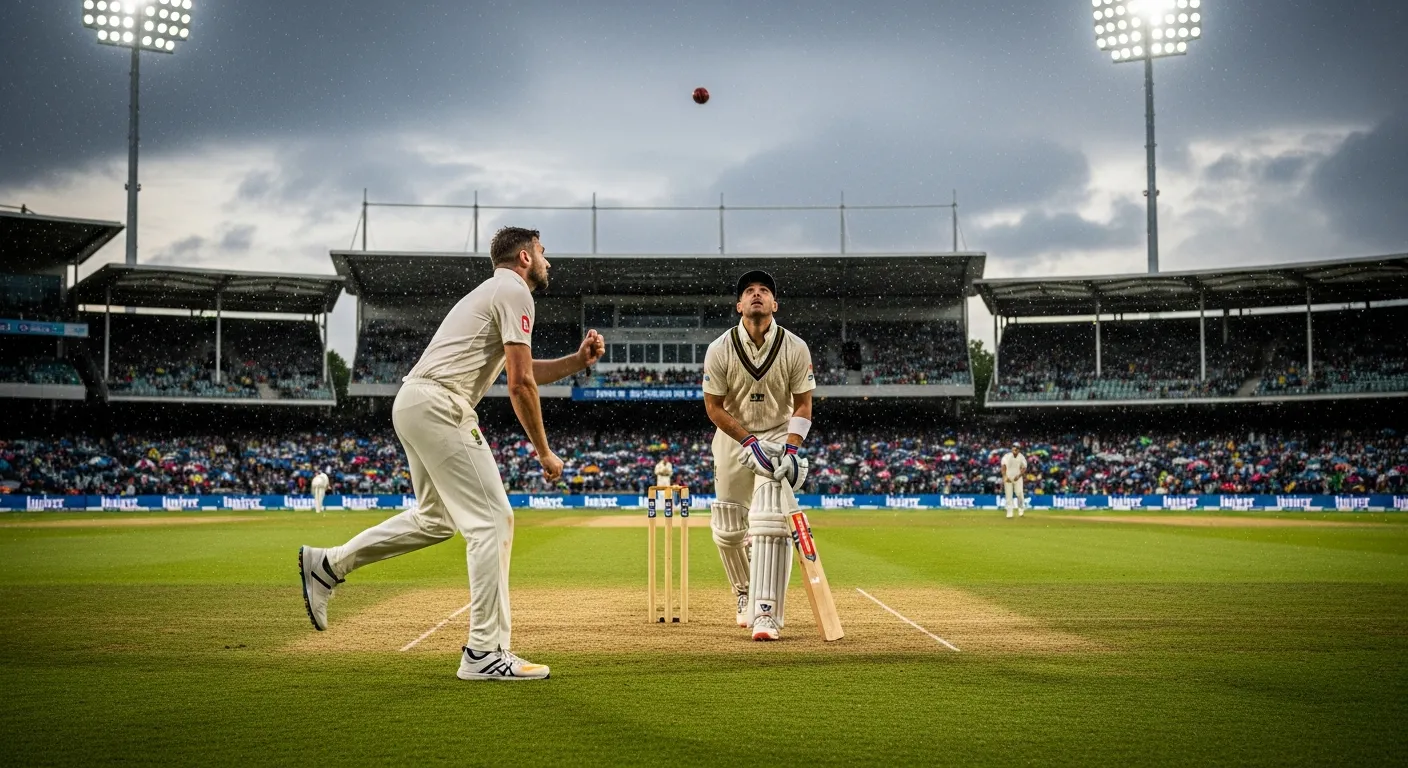
Test cricket cannot be played safely in rain or in poor light, which introduces a variable that shorter formats can largely avoid through scheduling flexibility but that a five-day contest must accommodate structurally.
Rain that stops play in a T20 match has a relatively small impact on the match's total available time perhaps fifteen or twenty minutes out of a three-hour contest. The same rain in a five-day Test match loses the equivalent fraction of a much longer total available playing time, making the proportional impact smaller. More importantly, a five-day structure provides natural recovery time if rain is forecast for days two and three of a Test match there are still two further full days of play in which the match can be completed.
The five-day duration is therefore not simply about cricket's traditions but about practical scheduling that gives Test matches the best realistic chance of producing a result despite the weather unpredictability that playing outdoors across multiple days necessarily involves.
What the Five Days Reveal That Shorter Formats Cannot
The specific qualities that Test cricket's five-day format reveals about players and teams are genuinely different from what limited overs formats measure, and they are qualities that cricket has always valued most highly in defining genuine excellence.
A batter who can occupy the crease across an entire day of Test cricket six hours of play, absorbing pressure from different bowling attacks across changing conditions, maintaining technical discipline through fatigue has demonstrated something qualitatively different from a batter who scores quickly in twenty overs. Both are genuine cricket skills. They are not the same skill.
A fast bowling attack that takes twenty wickets in a Test match bowling through multiple sessions across multiple days, adapting their plans as conditions change and as they accumulate physical fatigue has achieved something that cannot be directly compared to a bowling performance across four T20 overs.
A team that wins a Test match from a position of apparent difficulty following on, or chasing a large fourth innings target on a deteriorating pitch has displayed the collective resilience, tactical intelligence, and individual quality under extended pressure that cricket's most celebrated victories have always required.
These qualities are what the five days are designed to test. The format's duration is not incidental to its purpose. It is the mechanism through which the test is administered.
FAQ: Why is Test Cricket 5 Days
Why does Test cricket last 5 days?
Test cricket lasts five days because each team bats twice, requiring four innings to be completed. Taking twenty wickets and completing four innings of variable length requires significantly more time than single-innings limited overs formats. The five-day structure also provides a buffer for weather interruptions and allows the pitch to deteriorate naturally, producing strategic depth across the match.
How many overs are bowled in a Test match day?
A minimum of 90 overs must be bowled in a full day's Test match play. Play is typically divided into three two-hour sessions with a forty-minute lunch break and twenty-minute tea break. If play is interrupted by weather or poor light the umpires may extend sessions to ensure the minimum overs quota is met where possible.
What is a declaration in Test cricket?
A declaration is when the batting captain voluntarily closes their team's innings before all ten wickets have fallen, sacrificing potential additional runs in exchange for giving their bowling side more time to take the opposition's twenty wickets. It is a decision unique to Test cricket with no equivalent in limited overs formats.
What is the follow-on rule in Test cricket?
The follow-on allows the team batting first to require the team batting second to bat again immediately if the second team's first innings total falls more than 200 runs short of the first team's total in a five-day Test. The team batting first can choose whether to enforce the follow-on or bat again themselves.
Why do Test pitches change across five days?
Pitches deteriorate across a Test match through the physical impact of the ball, the wear from players' boots on the surface, and natural drying. As the match progresses, cracks develop, the surface becomes rougher and drier, and spin bowling increasingly effective. This deterioration creates a naturally changing contest across the five days rather than a static playing surface throughout.
Can a Test match end before five days?
Yes. If one team wins by bowling the opposition out twice and their runs total is sufficient, the match ends immediately regardless of how many days have been played. Some Test matches are decided in three or four days. If no result has been achieved after five days the match is officially declared a draw.