What Is a Duck in Cricket? Meaning, Types & Origin Explained
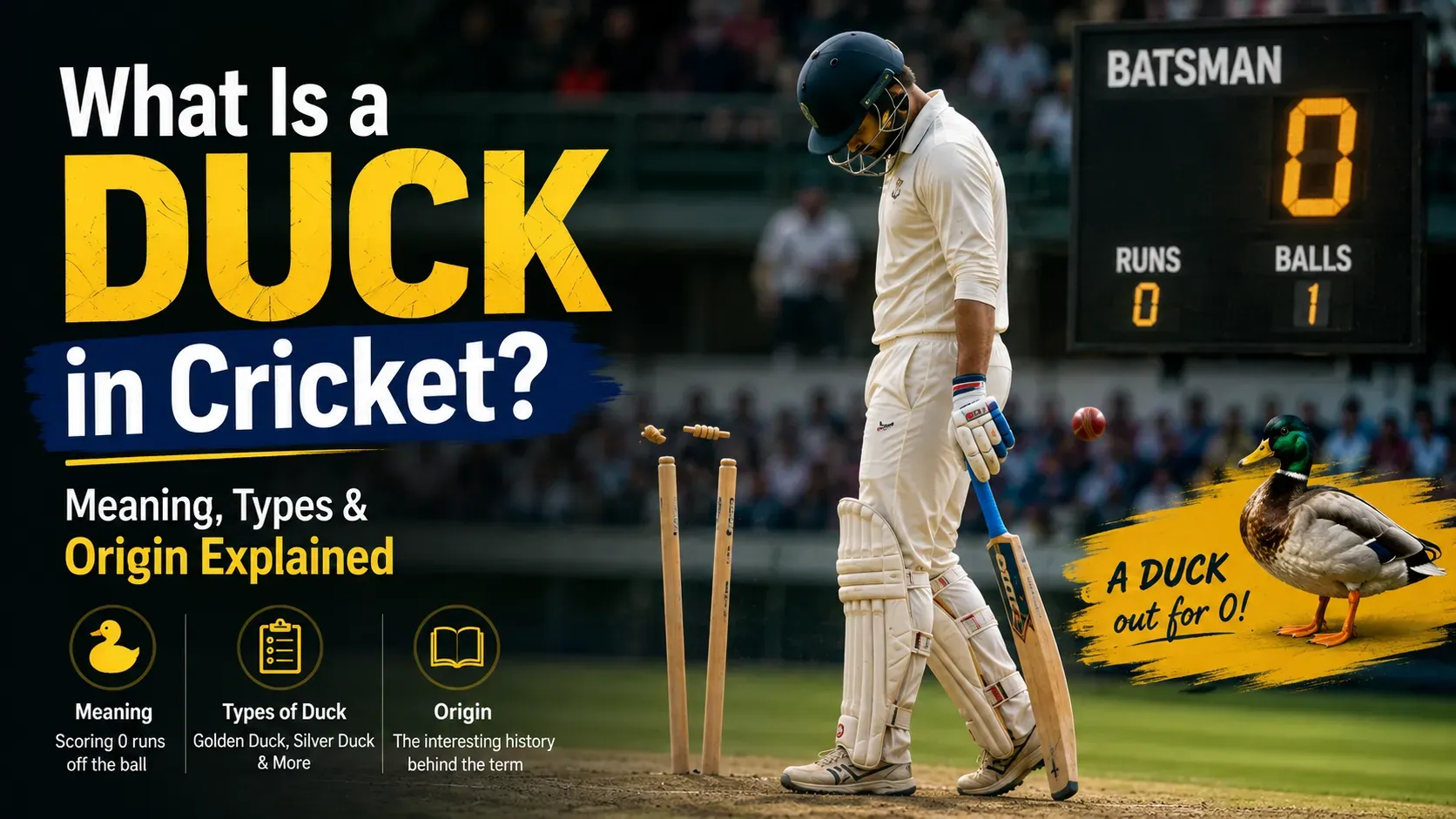
A duck in cricket is when a batter is dismissed without scoring a run. A score of 0 is only called a duck when the batter is out; a batter who remains not out on zero has not technically made a duck. The term comes from the older expression "duck's egg," referring to the shape of zero.
Quick answer
- What is a duck in cricket? A batter being dismissed for 0 runs.
- What is a golden duck? A batter being dismissed from the first ball faced.
- What is a diamond duck? A batter being dismissed without facing a legal delivery.
- What is a pair? A batter scoring a duck in both innings of a two-innings match.
- What is a king pair? A batter being dismissed from the first ball faced in both innings.
| Term | Meaning |
|---|---|
| Duck | Dismissed for 0 runs |
| Golden duck | Dismissed from the first ball faced |
| Silver duck | Dismissed from the second ball faced |
| Bronze duck | Dismissed from the third ball faced |
| Diamond duck | Dismissed without facing a legal delivery |
| Royal / Platinum duck | A less-standard term used in some cricket contexts for an innings first-ball duck |
| Pair | Ducks in both innings of a two-innings match |
| King pair | Golden ducks in both innings |
What is a duck in cricket?
A duck is when a batter's innings ends at zero because they were dismissed not because they simply hadn't scored yet. If a batter is still at the crease on zero when the innings closes, that's recorded as "0 not out," and it isn't called a duck. The distinction matters in the scorebook and in conversation: getting a duck specifically means the bowler or fielding side ended your innings before you got off the mark.
Types of ducks in cricket
Not every duck happens the same way, and cricket has built up specific terms for exactly how a batter got to zero.
What is a golden duck?
A golden duck is when a batter is dismissed off the very first ball they personally face. It's the version most casual fans recognize, since it's the "out first ball" moment that tends to get replayed.
What is a silver duck?
A silver duck is a dismissal off the second ball a batter faces, without having scored.
What is a bronze duck?
A bronze duck is a dismissal off the third ball faced, again without scoring. Silver and bronze ducks come up far less often in commentary than golden ducks, but they follow the same logic just one or two balls later.
What is a diamond duck?
A diamond duck is when a batter is dismissed without facing a legal delivery at all. This usually happens when a non-striker is run out, though it can also occur through a stumping or dismissal off a wide, since a wide isn't counted as a legal delivery faced.
What is a royal or platinum duck?
Royal duck (also called a platinum duck in some contexts) is a term used by some cricket sources for a batter being dismissed for a duck from the first ball of an innings the very first delivery of the match, not just the first ball that particular batter faces. The terminology here is not universally standardized, and you'll see it used inconsistently across different commentary teams and cricket publications.
What is a pair in cricket?
A pair isn't a type of duck on its own it's what happens when a batter scores a duck in both innings of a two-innings match, like a Test or a first-class game. Two ducks in one match, one per innings.
What is a king pair?
A king pair is the harshest version: a golden duck in both innings of the same match. Out first ball, twice, in the same game.
Why is it called a duck in cricket?
Origin of "duck's egg"
The term is a shortened version of "duck's egg," a 19th-century British phrase used because the number zero resembles the oval shape of an egg. It was already in circulation before Test cricket began in 1877. One of the earliest known references comes from July 1866, when the future King Edward VII, then the Prince of Wales, was dismissed for zero in a match at Sandringham a newspaper covering it wrote that he'd "retired to the royal pavilion on a duck's egg." Over time, the phrase was simply shortened to "duck," and it's stayed part of the sport's everyday language ever since.
Ned Gregory was dismissed for a duck in the first officially recognized Test match between Australia and England in 1877.
Famous ducks in cricket
Don Bradman's famous duck
Don Bradman's famous duck
- Player: Don Bradman
- Match: Australia vs England, 5th Ashes Test
- Venue: The Oval
- Date: 14 August 1948
- Score: 0
- Career Test batting average: 99.94
- Runs needed for a 100.00 career average: 4
Bradman walked out to bat for the final time in his Test career needing just four runs to finish with a career average of exactly 100 a mark no batter has come close to before or since. The England team gave him a standing ovation as he came out. Two balls later, leg-spinner Eric Hollies bowled him with a googly, and Bradman was gone for a duck. That single dismissal is the reason his career average sits at 99.94 rather than 100, arguably the most famous statistic in cricket, built entirely around the four runs a duck denied him.
Who Has the Most Ducks in Test Cricket?
| Rank | Player | Ducks | Scope | Team |
|---|---|---|---|---|
| 1 | Courtney Walsh | 43 | Test cricket | West Indies |
| 2 | Stuart Broad | 39 | Test cricket | England |
| 3 | Chris Martin | 36 | Test cricket | New Zealand |
| 4 | Glenn McGrath | 35 | Test cricket | Australia |
| 5 | Shane Warne | 34 | Test cricket | Australia |
| 6 | Ishant Sharma | 34 | Test cricket | India |
| 7 | James Anderson | 34 | Test cricket | England |
| 8 | Muttiah Muralitharan | 33 | Test cricket | Sri Lanka |
| 9 | Zaheer Khan | 29 | Test cricket | India |
| 10 | Jasprit Bumrah | 28 | Test cricket | India |
| 11 | Curtly Ambrose | 26 | Test cricket | West Indies |
| 12 | Merv Dillon | 26 | Test cricket | West Indies |
| 13 | Danish Kaneria | 25 | Test cricket | Pakistan |
| 14 | Danny Morrison | 24 | Test cricket | New Zealand |
| 15 | Bishan Singh Bedi | 20 | Test cricket | India |
Who has the most ducks in international cricket?
The "most ducks" record books are dominated almost entirely by bowlers, not specialist batters, which makes sense once you consider why tailenders bat because the rules require eleven players, not because they've trained for it.
| Player | Ducks | Scope |
|---|---|---|
| Muttiah Muralitharan | 59 | All international formats combined (Tests, ODIs, T20Is) |
A note on this data: sources vary slightly on exact duck counts for older careers, depending on how each database counts innings. These figures are cross-checked across multiple cricket statistics sites; for the fully current, continuously updated numbers.
Does 0 not out count as a duck?
No. A batter must actually be dismissed for the innings to be recorded as a duck. A batter who finishes an innings on 0 not out because their team won, declared, or ran out of overs hasn't made a duck, even though the scoreboard shows the same number.
Can a batter score a duck without facing a ball?
Yes that's the diamond duck described above. The most common way it happens is a non-striker being run out while backing up, meaning the batter never faces a single legal delivery themselves before their innings ends.
Duck vs golden duck vs diamond duck
| Term | Runs | Key condition |
|---|---|---|
| Duck | 0 | Batter is dismissed |
| Golden duck | 0 | Dismissed from first ball faced |
| Silver duck | 0 | Dismissed from second ball faced |
| Bronze duck | 0 | Dismissed from third ball faced |
| Diamond duck | 0 | Dismissed without facing a legal delivery |
| Pair | 0 + 0 | Duck in both innings |
| King pair | 0 + 0 | Golden duck in both innings |
Royal/platinum duck terminology is not universally standardized across cricket sources and is left out of this comparison table for that reason.
Examples of ducks in cricket
- A batter faces five legal balls and is caught after scoring 0. Result: duck.
- A batter is dismissed off the first legal ball they face, without scoring. Result: golden duck.
- A batter is run out before facing a single legal delivery. Result: diamond duck (terminology can vary slightly by source).
- A batter finishes an innings on 0, not out. Result: not a duck.
- A batter is dismissed for 0 in both innings of a match. Result: pair.
- A batter is dismissed off the first ball faced in both innings of a match. Result: king pair.
Related guides
If you're building out your cricket vocabulary, these cover other common terms and rules: What Is a Maiden Over in Cricket?, What Is a No Ball in Cricket?, What Is a Free Hit in Cricket?, What Is LBW in Cricket?, and Cricket Fielding Positions Explained.
Frequently asked questions
What does it mean to score a duck in cricket?
It means the batter was dismissed after scoring 0 runs.
Does 0 not out count as a duck?
No. A batter must be dismissed for 0 for the innings to be recorded as a duck.
What is a golden duck in cricket?
A golden duck occurs when a batter is dismissed from the first ball they face.
What is a diamond duck in cricket?
A diamond duck generally means a batter is dismissed without facing a legal delivery.
What is a pair in cricket?
A pair means a batter is dismissed for 0 in both innings of a two-innings match.
What is a king pair?
A king pair means the batter is dismissed from the first ball faced in both innings.
Why is zero called a duck in cricket?
The term is linked to the older expression “duck’s egg,” referring to the oval shape of zero.